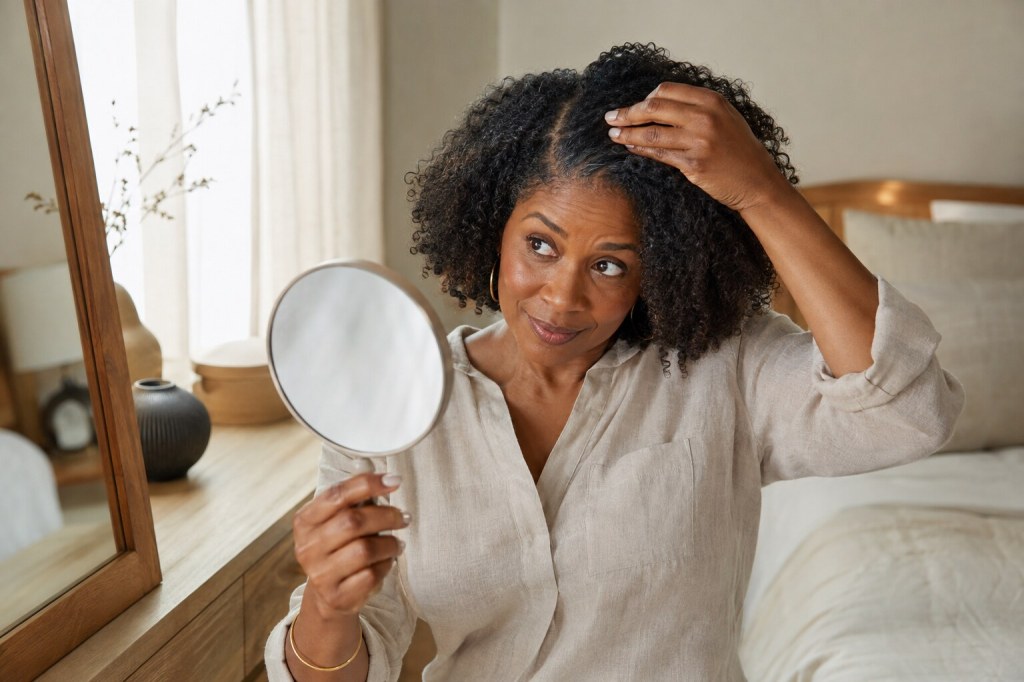
Somewhere in midlife, your hair may decide the style consultation is over and it will now be pursuing its own creative direction.
The curl pattern changes. The ends feel drier. The ponytail seems less ambitious. A part that once behaved like punctuation starts widening into a full paragraph. Meanwhile, the internet has diagnosed a deficiency, prescribed twelve gummies and placed a red-light helmet in your cart before you have finished asking, “Wait—what actually changed?”
This is where beauty advice becomes much more useful when it stops treating “my hair is different” as one problem.
The plot twist is not one thing
Hair can look thinner because there are fewer strands, because individual strands are becoming finer, because more hair is shedding, because strands are breaking, or because a new texture no longer creates the same visual volume. Those are different events. They do not automatically have the same cause, and they do not deserve the same shopping list.
Aging and the menopausal transition may both influence the hair follicle and hair cycle, but the research is still developing. Genetics, styling practices, illness, major weight change, medication, nutritional status, thyroid conditions, stress and inflammatory or autoimmune disorders can also matter. “Hormones” may be part of the story; it should not become a convenient ending before the middle has been read.
1. Texture changed, but density may not have
Hair that suddenly feels rougher, flatter, curlier, straighter, frizzier or less cooperative is not necessarily falling out. The fiber itself can change with age, environmental exposure and accumulated chemical or heat damage. Gray hair may also behave differently from pigmented hair. A routine built for your previous texture can begin producing deeply average results on your current one.
Before declaring a crisis, try the least cinematic explanation: your hair may need different handling. Gentler cleansing, regular conditioning, less heat, less tension and fewer overlapping chemical services can reduce breakage. The American Academy of Dermatology recommends gentle shampooing, conditioning and minimizing trauma when hair is thinning or fragile.
A new texture is allowed to need a new technique. It is not a moral failure of your old shampoo.
2. Breakage and shedding are not synonyms
Breakage happens along the hair shaft. You may see shorter pieces, uneven ends, frizz and snapping—often where heat, bleach, friction or tight styling has repeatedly stressed the fiber.
Shedding releases a whole strand from the follicle. The AAD distinguishes excessive shedding—often called telogen effluvium—from progressive hair loss. A major illness, operation, significant weight change, intense stressor or hormonal shift can precede noticeable shedding by months, which is why the cause is not always obvious when the shower drain finally files its complaint.
The distinction matters because repairing ends cannot stop a follicle-level process, and swallowing a supplement cannot undo mechanical breakage.
3. A widening part deserves more than volumizing powder
Female pattern hair loss often begins with a widening part, reduced ponytail volume or gradual thinning over the top of the scalp. It commonly appears in midlife and tends to progress. The AAD advises seeing a dermatologist because several forms of hair loss can look similar, while early identification can preserve more options.
This is especially important when loss is rapid, patchy, painful, itchy or accompanied by redness, scaling, pustules, a smooth or scar-like area, or eyebrow changes. Some scarring forms of alopecia can permanently damage follicles. “Wait and see” is not always the neutral choice it appears to be.
And because hair loss can intersect with iron status, thyroid function, medications, major weight change and other health factors, the answer is sometimes found in a history—not in the beauty aisle.
4. The supplement plotline arrives far too early
Hair supplements are sold with the confidence of a product that knows you will not be measuring individual follicles.
Biotin is the classic example: deficiency can affect hair, but deficiency is not the default explanation for every woman with a disappointing ponytail. High-dose biotin can also interfere with certain laboratory tests. Iron is essential, but taking it without knowing whether you need it is not precision wellness. The correct deficiency matters; more of an irrelevant nutrient is still irrelevant.
Before buying a “hair complex,” ask: What is the proposed cause? Which ingredient addresses it? Is there evidence in people with my type of hair change? What would success look like, and how long would it reasonably take to see?
That is the same Evidence, Experience and Economics filter used in The Supplement Cabinet Audit. Hair growth is slow; marketing should not be allowed to use that delay as camouflage.
The one-photo rule
If you are unsure whether density is changing, take one clear photo of your center part, temples and ponytail under the same lighting, from the same angle, no more than once a month. Daily inspection turns normal variation into suspense. Consistent monthly images can show whether a pattern is actually progressing and give a dermatologist something more useful than “I think it used to be fuller.”
Also write down the timing of any illness, surgery, medication change, rapid weight change, unusually heavy bleeding, major stressor or change in cycle. You are not building a case against your body. You are giving the timeline back its context.
What not to buy in a panic
- A complete replacement routine. Change one or two variables so you can tell what helped.
- Six scalp actives at once. Irritation can create a new problem on top of the first one.
- A device before a diagnosis. “FDA cleared” may apply to a specific device and indication; it does not mean every hair-loss mechanism will respond.
- Enough supplements to make your laboratory results mysterious. More is not a strategy.
- Shame disguised as urgency. Hair changes can be emotionally significant without being evidence that you have neglected yourself.
The better beauty question
“How do I get my old hair back?” is understandable, but it bundles texture, density, breakage, shedding and identity into one impossible assignment.
A better sequence is:
- What changed: texture, shaft breakage, shedding, density—or more than one?
- When did it begin, and was the change gradual or sudden?
- Is the scalp comfortable and visibly healthy?
- What happened two to four months before the change became obvious?
- Does this need gentler care, clinical evaluation, or both?
Midlife hair does not need to be treated as a renovation project. But it does deserve the dignity of an accurate question—especially before the algorithm turns uncertainty into a subscription.
Related: When Your Face Suddenly Looks Different.
Sources and further reading
- American Academy of Dermatology: Female Pattern Hair Loss
- American Academy of Dermatology: Hair Loss or Excessive Shedding?
- American Academy of Dermatology: Tips for Managing Hair Loss
- Clinical and Experimental Dermatology review: Menopause, Skin and Common Dermatoses—Hair Disorders
This article is educational and is not medical advice or a diagnosis. Hair and scalp changes have many possible causes. Consult a qualified healthcare professional or board-certified dermatologist about sudden, progressive, patchy, painful, inflamed or otherwise concerning changes, and before starting supplements or treatment. See the AbundantlyMari editorial and wellness disclaimer.
 AbundantlyMari
Leave a comment