Longevity advice often arrives as though one body can stand in for everyone. Women’s aging makes that assumption increasingly difficult to defend.
The longevity world loves a universal protocol.
The perfect fasting window. The correct training split. The supplement stack with just enough obscure molecules to make ordinary breakfast feel embarrassingly unsophisticated.
Then the subject becomes a woman in midlife, and suddenly the universal protocol develops several footnotes.
This is not because women need a pink version of longevity. It is because muscle, bone, sleep, cardiovascular risk and the menopause transition belong in the picture. A 2026 review in Ageing Research Reviews makes the scientific case for treating sex as a biological variable when studying longevity interventions. It also makes the limit clear: much of that intervention literature remains preclinical. Interesting differences in mice are not personalized instructions for a woman standing in her kitchen.
A longer life is not the only outcome. The real ambition is a life you can still carry, enter and enjoy.
WHAT CHANGES WHEN THE SUBJECT IS A WOMAN?
Muscle: capability matters more than simply becoming smaller.
Bone: menopause-related loss brings screening and prevention into the conversation earlier.
Sleep: symptoms and physiology can complicate the fantasy that bedtime discipline solves everything.
Cardiovascular health: midlife is a useful prevention window, not a reason for panic.
Experimental interventions: sex differences in models are a reason for better research, not a reason to invent a women-only stack.
Muscle becomes a longevity asset, not a cosmetic problem
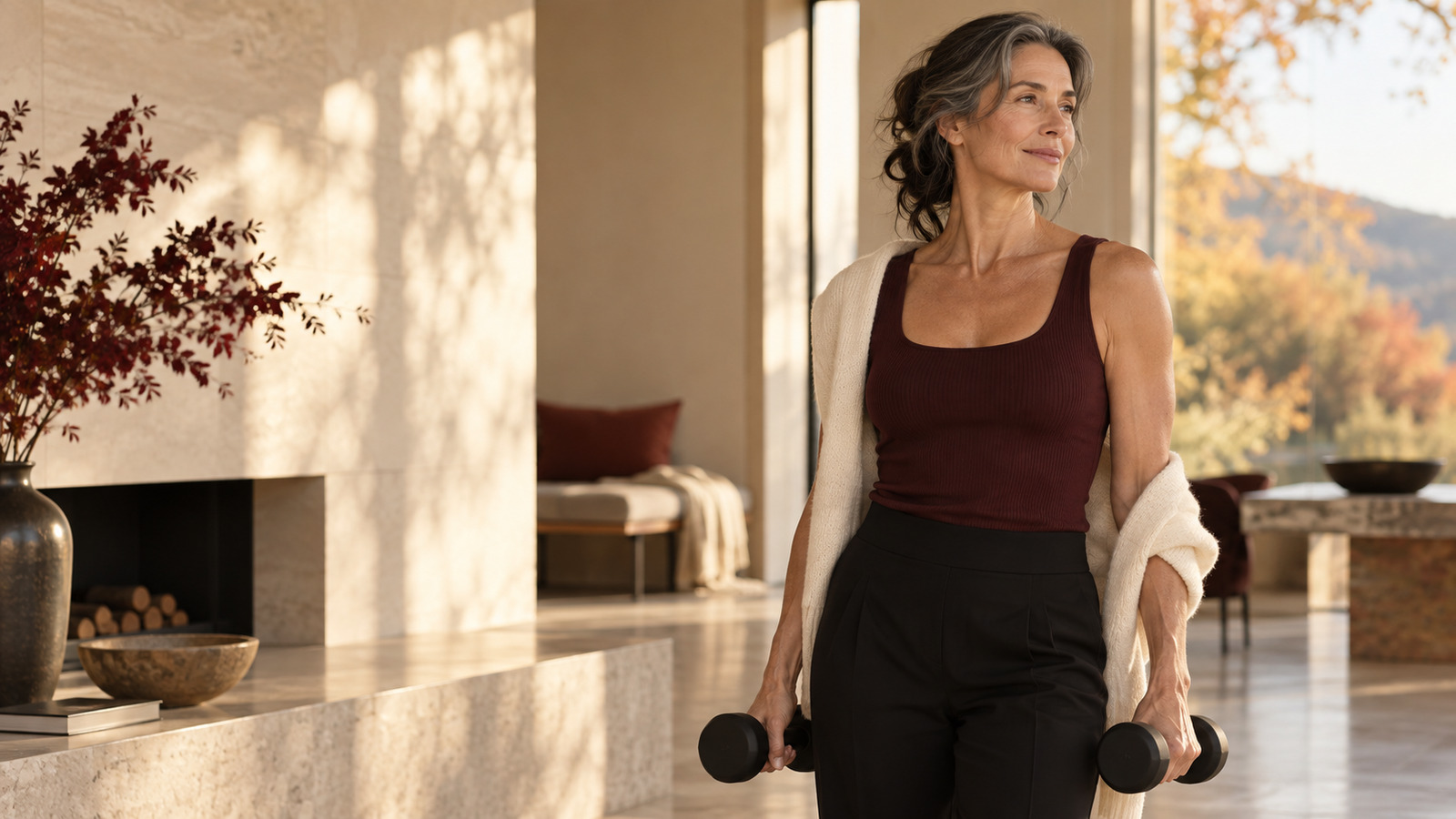
Women have spent decades being sold exercise as a way to occupy less space. Midlife offers a better assignment: build the strength to keep participating fully in your own life.
Longitudinal data from the Study of Women’s Health Across the Nation found that, around the final menstrual period, fat gain accelerated and lean mass began to decline on average. That does not mean every woman follows the same path. It does mean that weight alone becomes an especially poor narrator.
Strength work supports muscle and physical function; weight-bearing activity also belongs in a bone-health strategy. The World Health Organization recommends muscle-strengthening activity involving major muscle groups on at least two days each week for adults, alongside aerobic activity. The exact plan still needs to fit the person, her health and her starting point.
We explored the larger argument in The Midlife Muscle Conversation Is Bigger Than Weight Loss. The useful question is no longer only, “What do I weigh?” It is also, “What can I lift, recover from and continue doing?”
Bone health cannot wait until something breaks
Bone is easy to ignore because most of us cannot feel it changing. Yet longitudinal research shows that bone loss can accelerate across the menopause transition.
This is where a careful article must resist turning “women’s longevity” into another universal checklist. Screening is not identical for everyone. The U.S. Preventive Services Task Force recommends osteoporosis screening for women 65 and older, and for postmenopausal women younger than 65 who are at increased fracture risk after clinical risk assessment. That is a conversation about age and individual risk, not permission for every 42-year-old to order an unsupervised scan.
It also changes the way aggressive dieting should be judged. A plan that produces a smaller body while eroding nutrition, muscle or training capacity is not automatically a longevity win.
Sleep is infrastructure, not a side quest
Sleep advice is often written as though the whole problem is a phone too close to the bed. Sometimes it is. Midlife can also bring hot flashes, night sweats, changing sleep patterns, stress, caregiving, pain, alcohol effects, sleep apnea or several of these at once.
Human longitudinal studies have found sleep symptoms can change across the menopause transition, while also showing how much variation exists between women. The important point is not to blame every difficult night on hormones. It is to stop treating repeated disruption as a failure of character.
If the 3 a.m. wake-up has become familiar, The 3 A.M. Wake-Up Is Not a Personality Flaw is a more useful place to begin than another device promising to grade the night you just survived.
Cardiovascular prevention deserves a female lens
Women tend to live longer than men. Longevity is not the same as spending those additional years in ideal health.
The American Heart Association describes the menopause transition as an important window for cardiovascular prevention. That does not make menopause a diagnosis. It means blood pressure, lipids, blood glucose, smoking, activity, sleep, pregnancy history and family history should not be deferred as concerns for a much older version of you.
The goal is not to become alarmed by every number. It is to know which numbers belong to your baseline, how they are changing and when the pattern deserves a clinical conversation.
THE WOMEN’S LONGEVITY EVIDENCE LADDER
FOUNDATIONS
Strength, movement, sufficient nutrition, sleep, meaningful connection, tobacco avoidance and appropriate preventive care.
INDIVIDUAL CLINICAL DECISIONS
Screening, treatment and risk reduction based on age, symptoms, history, medications and professional assessment.
EMERGING INTERVENTIONS
Promising molecules, tests and protocols that may have biologic rationale but do not yet have strong human evidence for broad use in women.
The ladder is also the spending order: do not allow the experimental layer to quietly replace the foundations beneath it.
The experimental layer needs more humility
The 2026 review of sex differences in longevity interventions is fascinating because it shows how often male and female research animals respond differently to interventions designed to extend lifespan or healthspan. It is also sobering because the distance from that finding to a confident human protocol remains large.
Findings in mice are an exciting beginning, and studies in women will reveal the ideal dose, safety, timing and benefit. It certainly does not tell us how menopause, medications, training, nutrition and individual disease risk interact with that intervention.
This is why the hierarchy in The Longevity Hierarchy matters. The question is not whether new science is exciting. It is whether the excitement has earned authority over foundations with far stronger human evidence.
BEFORE A LONGEVITY PROTOCOL EARNS A PLACE
- Has it been tested in humans, or mainly in cells and animals?
- Were women included, and were outcomes reported by sex?
- Is the proposed benefit meaningful to your life?
- What are the trade-offs, contraindications and monitoring burden?
- Would the money and attention improve a stronger foundation instead?
What I would carry forward
- Protect capability, and the glow follows. Muscle, mobility, balance and bone deserve real attention.
- Know the baselines that change decisions. More data is not automatically better; useful context is.
- Treat sleep as part of healthspan. Persistent disruption deserves curiosity, not self-criticism.
- Be suspicious of universal protocols. Especially when women were missing from the evidence used to build them.
- Keep emerging science in its proper place. Promising is a research status, not a shopping instruction.
The most intelligent longevity plan for a woman may look less spectacular than the internet promised. It may involve strength, food, sleep, preventive care, treatment when needed, ordinary friendship and the freedom to change the plan when the body changes.
Which is very close to the argument in Your Longevity Plan Needs More Tuesday-Night Dinner: a life designed to last should still resemble a life.
Editorial note: Abundantly is an editorial publication, not a medical practice. This article discusses population-level evidence and general health concepts; it is not an individualized exercise, screening or treatment plan. Personal risk, symptoms and medical decisions belong with an appropriate licensed healthcare professional.
Sources & further reading: Sex differences in response to longevity interventions; SWAN: body-composition changes across the menopause transition; WHO physical-activity guidelines; USPSTF osteoporosis-screening recommendation; AHA scientific statement on menopause and cardiovascular risk; Sleep symptoms signaling the menopausal transition.
Leave a Reply