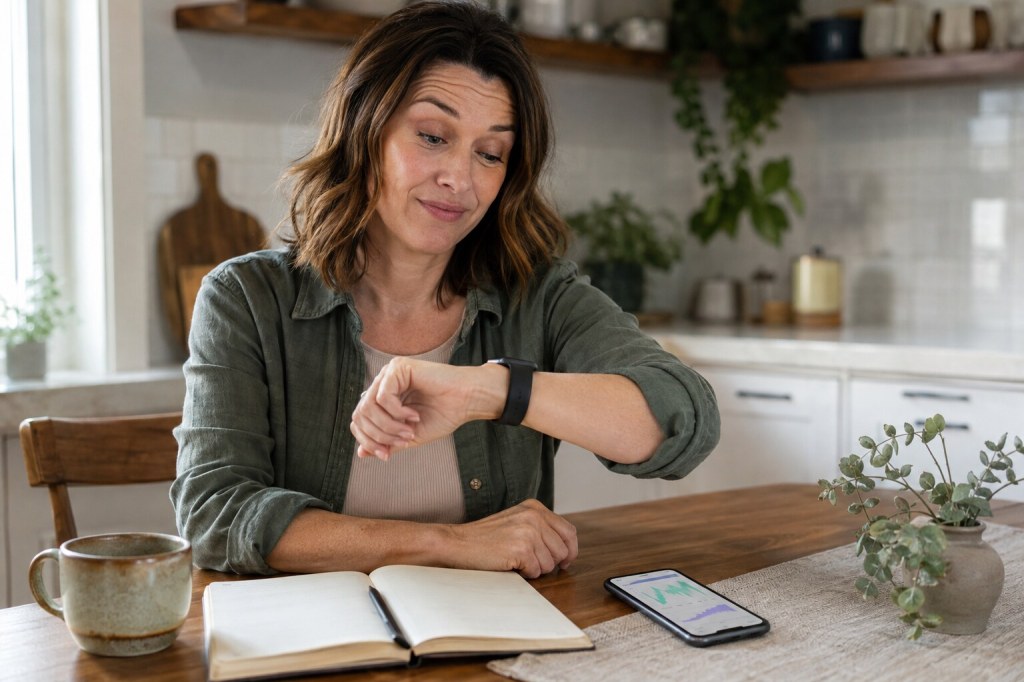
Your wearable is a very confident intern.
It arrives early. It collects enormous amounts of information. It produces attractive reports before you have asked a clear question. Some of the work is excellent. Some of it is an estimate dressed for a board meeting.
The mistake is not wearing the device. The mistake is promoting it to chief medical officer because the dashboard used a serious shade of blue.
Every wearable report has three layers
To use a wearable intelligently, separate what it sensed from what it calculated and what the app concluded.
Layer 1: the sensor
A wrist or ring device may detect movement, light reflected through tissue, skin temperature or electrical signals, depending on its hardware. Even here, fit, placement, movement, skin contact, tattoos, circulation, device design and the activity being performed can affect the signal.
Layer 2: the algorithm
The device converts those signals into estimates: steps, sleep periods, sleep stages, energy expenditure, recovery, stress or readiness. Some metrics are closer to direct measurement than others. A heart-rate value and a “body battery” score do not have the same evidentiary status simply because they appear on neighboring cards.
Layer 3: the story
“You are well recovered.” “Your cardiovascular age improved.” “Today should be easy.” This is interpretation—the app’s attempt to turn multiple inputs into a useful narrative.
Stories can help people act. They can also make uncertainty disappear too neatly.
Measured, estimated and interpreted are three different verbs. Your dashboard benefits when you remember which one you are looking at.
The intern’s strongest work
Consumer wearables can be excellent at consistency. A device worn in the same way over time may reveal patterns that memory misses: a resting heart-rate trend, a change in sleep timing, reduced movement during a difficult month, or the relationship between late alcohol and fragmented sleep.
This is where personal baselines often matter more than population-perfect numbers. A stable trend from the same device under similar conditions can be useful even when the value is not laboratory-grade.
Systematic reviews have found that accuracy depends heavily on the metric, device and setting. Heart rate and step counts are often more usable than calorie estimates. Energy-expenditure estimates, in particular, have performed poorly across devices in multiple validation studies. The correct response is not “wearables are useless.” It is “stop treating every tile on the dashboard as equally mature.”
The work that needs supervision
Sleep stages
A consumer device can estimate when you were asleep and how your night changed, but it does not observe the brain, eye movements, muscle tone, breathing and other signals in the same way as a clinical sleep study. The American Academy of Sleep Medicine says consumer sleep technology should not replace validated diagnostic testing or a clinical evaluation.
If the watch congratulates you after a terrible night, you do not have to file an appeal. Start with the distinction explored in Your Wearable Says You Slept Fine. You Disagree. Who’s Right?: the device reports a model; you report an experience. Both can contain information.
Calories burned
Calorie estimates combine sensor data with assumptions about body size, activity and physiology. In reviews of commercial wearables, energy expenditure has generally been less accurate than heart rate and step counts. Treat the number as a rough model, not an invoice your body must reconcile with dinner.
HRV and recovery scores
Heart-rate variability can be measured in different ways, over different time windows, in different positions and under different conditions. A 2025 validation study found that nocturnal resting heart rate and HRV accuracy varied among tested consumer devices. This is why comparing your score with someone else’s—or comparing two platforms as if they speak an identical language—can be misleading.
HRV is not a verdict on whether you are resilient, regulated or “doing health correctly.” It is one physiological signal influenced by sleep, illness, alcohol, training load, stress, measurement conditions and individual variation.
“FDA cleared” does not bless the entire dashboard
This distinction deserves a permanent place in wearable literacy.
The FDA separates low-risk general-wellness products from medical devices intended to diagnose, treat, mitigate or prevent disease. A company may have authorization for one specific feature while offering many other wellness estimates that were not reviewed for the same purpose.
In January 2026, the FDA updated its general-wellness guidance. The practical consumer question remains simple: Which exact feature was reviewed, for which use, in which population, and what does the company actually claim it can do?
The word “medical-grade” should never be allowed to float freely across an entire ecosystem.
How to manage your very confident intern
- Give it one job. “Help me keep a consistent wake time” is better than “optimize my health.”
- Learn the data lineage. What is directly sensed? What is calculated? What is a composite score?
- Use the same device consistently. Switching platforms can create an apparent change that is really a change in hardware or algorithm.
- Prefer trends over single-day drama. One red score may be noise. A persistent shift can be a useful question.
- Write the decision rule first. What will you do differently if the trend changes?
- Record major context. Travel, illness, alcohol, medication changes, menstrual cycle, unusual training and disrupted sleep can help explain the graph.
- Escalate symptoms, not scores. Persistent or concerning symptoms deserve professional evaluation regardless of whether the wearable notices.
When to send the intern home
A device has stopped being useful when it creates more checking than action, makes a good morning feel bad, replaces symptoms with scores, or demands attention without improving a decision.
Try a dashboard vacation. Keep wearing the sensor if you want continuity, but stop viewing the daily score for a week. Notice whether behavior becomes wiser, worse or exactly the same. If nothing useful changes, the metric may have been entertainment wearing clinical typography.
Our earlier guide, The Midlife Data Worth Tracking Before Your Next Appointment, offers a smaller set of questions for deciding what belongs in a health conversation.
The promotion it has actually earned
Your wearable does not need to be perfectly accurate to be useful. It needs to be accurate enough for the decision you are asking it to support—and humble enough in your mind that a number never outranks a symptom, a pattern or a qualified evaluation.
Keep the intern. Give it a narrow brief. Review the work. And under no circumstances let it schedule a meeting about your readiness score before coffee.
Sources and further reading
- FDA: General Wellness—Policy for Low-Risk Devices, January 2026
- American Academy of Sleep Medicine: Consumer Sleep Technology Position Statement
- JMIR systematic review: Wearables Measuring Steps, Energy Expenditure and Heart Rate
- Physiological Reports: 2025 Validation of Nocturnal Resting Heart Rate and HRV in Consumer Wearables
This article is educational and is not medical advice. Consumer-wearable data cannot diagnose or exclude a health condition and should not replace professional evaluation or validated testing. Seek qualified care for persistent, severe or concerning symptoms regardless of a device score or alert. See the AbundantlyMari editorial and wellness disclaimer.
 AbundantlyMari
Leave a comment