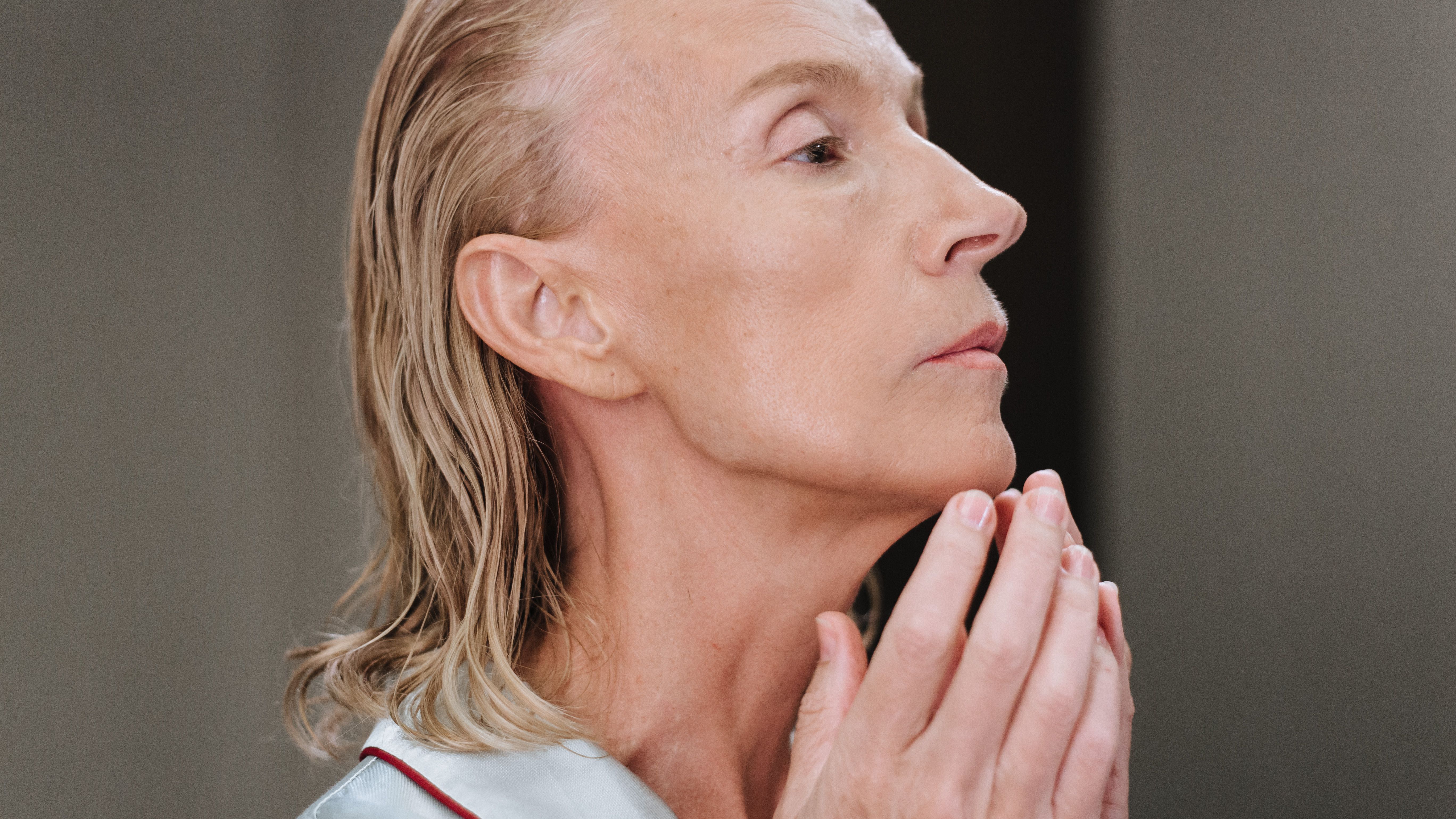
At some point, “mature skin” became a reason to sell women a heavier jar, a longer routine and a more expensive promise.
But a moisturizer does not become appropriate because the label says 40+, 50+ or “age renewal.” It earns its place by doing the jobs your skin needs now: attracting water, smoothing the spaces between skin cells, reducing water loss and remaining comfortable enough that you will use it consistently.
Skin can become drier and more easily irritated with age, while weather, cleansing habits, medications, hormonal change and existing skin conditions can alter the same routine in different ways. The useful question is not Which age cream should I buy? It is What is my skin asking this formula to do?
THE MATURE-SKIN RESET
KEEP
Daily sunscreen, gentle cleansing and a moisturizer you can use without irritation.
CONSIDER
A cream or ointment, fragrance-free options and a formula combining more than one moisturizing job.
PAUSE
Stripping cleansers, constant active stacking and the idea that richer, pricier or “age-defying” automatically means better.
Every skin after 40 tells its own story
There is no midnight switch that makes one moisturizer correct on your fortieth birthday. The National Institute on Aging notes that aging is one contributor to dry, rough skin, alongside dry environments, sun exposure, smoking and other factors. That is why two women of the same age may need very different textures.
If your face feels comfortable, makeup sits well and you are not seeing new flaking, stinging or tightness, you do not need to replace a working moisturizer simply because a campaign says your skin has entered a new decade. If a lotion disappears without relieving tightness, however, moving toward a cream or ointment can make sense. The American Academy of Dermatology specifically recommends starting with a cream or ointment rather than a lotion for dry skin.
Three jobs can matter more than one hero ingredient
THREE JOBS · ONE JAR
HUMECTANTS
Help the outer layer hold water. Look for glycerin, urea or hyaluronic acid.
EMOLLIENTS
Fill and smooth the spaces between skin cells. Ceramides, fatty acids and many oils can play this role.
OCCLUSIVES
Form a film that slows water loss. Petrolatum, mineral oil and dimethicone are familiar examples.
These categories overlap, and a complete formula matters more than a single ingredient highlighted on the front of the jar. A moisturizer can combine water-binding ingredients with lipids and an occlusive layer. The balance determines whether it feels elegant, greasy, soothing, insufficient, or exactly right.
Ceramides: useful biology, not automatic superiority
Ceramides are part of the lipid matrix in the outer skin layer and play a meaningful role in barrier function. That makes them a reasonable ingredient to consider when dryness or barrier disruption is the problem. But “contains ceramides” does not tell you the concentration, delivery, supporting lipids or how the finished formula performs on your skin.
A systematic review of ceramide moisturizers in atopic dermatitis found signals of benefit but also substantial variation across formulations and studies. That is a useful reminder for ordinary cosmetic shopping: the ingredient name is evidence of an ingredient, not proof that every ceramide cream is clinically superior to every simpler moisturizer.
Urea: hydration at one concentration, exfoliation at another
Urea is both a component of the skin’s natural moisturizing system and a versatile topical ingredient. At lower concentrations it is used primarily for hydration; at higher concentrations it becomes more keratolytic, helping loosen thickened scale. A dermatology review of urea emphasizes that its effects vary with concentration.
That does not make a high-percentage foot cream an upgraded face cream. Higher-strength urea can sting irritated or cracked skin, and products designed for thick heels or plaques are solving a different problem from facial tightness. Read the concentration and intended body area rather than treating “more urea” as “more moisture.”
Petrolatum is not glamorous. It is still useful.
Petrolatum reduces water loss by forming an occlusive film. It can be extremely useful on very dry areas or as the final layer over a moisturizer, especially when fragrance and long ingredient lists are poorly tolerated. It can also feel too heavy for some faces or routines.
This is where experience matters. The most beautiful results come from the product you love applying every day. Texture is not frivolous; it is part of adherence.
THE BARRIER-CLAIM DECODER
“Supports the moisture barrier”
Look for the actual moisturizing system and how the product was tested. The phrase is not a standardized formula.
“Clinically tested”
Ask: tested against what, for how long, in how many people and for which outcome: hydration, water loss, comfort or appearance?
“Repairs skin”
Moisturizing is a cosmetic claim. Claims to treat disease or affect skin structure or function can move a product into drug territory under U.S. law.
The distinction matters because “barrier repair” can be used as a broad beauty phrase even when the evidence is simply that a formula improves hydration for several hours. That may still be useful. It is just not the same as proving treatment of eczema, rosacea or another condition. The FDA’s cosmetics-claims guidance explains the regulatory line between appearance-focused cosmetic claims and claims to treat disease or affect structure or function.
What skin may need less of after 40
- Constant stripping. If skin feels tight after cleansing, that sensation is not proof that it is exceptionally clean.
- Fragrance as a performance signal. A luxurious scent does not make a moisturizer more effective, and fragrance-free products are often easier for dry or sensitive skin to tolerate.
- Every active in one evening. Retinoids, acids and exfoliating treatments may still have a place, but moisturizer should not be forced to rescue a routine that repeatedly exceeds your skin’s tolerance.
- Age-coded urgency. You do not need a separate neck, jawline and “menopause” moisturizer unless the formulas solve genuinely different needs.
How to choose the next jar
THE FOUR-QUESTION FIT TEST
- What is the actual problem? Tightness, flaking, stinging, rough body skin, product irritation or simply a texture preference?
- What job is missing? More water-binding humectants, more emollient richness, a stronger occlusive layer, or fewer irritating extras?
- Where will you use it? Face, eyelids, hands, body and heels do not necessarily need the same concentration or finish.
- Can you use it twice daily for two weeks? Comfort, pilling, scent, packaging and price all influence whether a formula receives a fair trial.
Patch-test a new product when your skin is reactive, and change one meaningful variable at a time. Apply moisturizer to slightly damp skin after gentle cleansing or bathing. If daytime sunscreen pills, try a lighter layer or allow more time between products rather than abandoning sun protection.
This is the practical continuation of our fall skincare field guide. It also follows the standard in How to Read a Beautiful Claim with Confidence: look at the whole formula and the finished promise together.
The AbundantlyMari moisturizer audit
EVIDENCE · EXPERIENCE · ECONOMICS
Evidence
Does the complete formula support the outcome being promised, or is one fashionable ingredient carrying the story?
Experience
Does it relieve tightness without stinging, pilling or turning the routine into a negotiation?
Economics
What does a month cost at the amount you actually use, and is an age label charging you for a promise rather than performance?
The verdict
Mature skin does not need to be treated as a renovation project. It may need gentler cleansing, a more complete moisturizing system, a texture that reduces water loss and fewer products competing for tolerance.
Start with the symptom, then choose the formula. Ceramides can be useful. Urea can be useful. Glycerin and petrolatum can be useful. None of them makes a jar universally superior, and none replaces sunscreen, a tolerable routine or medical evaluation when something more than ordinary dryness is happening.
Persistent cracking, bleeding, intense itching, burning, a spreading rash or dryness that does not improve can signal eczema, contact dermatitis, infection or another condition. This article is here to educate and inspire; a dermatologist or other trusted clinician is a wonderful partner when symptoms are persistent, severe or concerning.
Sources
- American Academy of Dermatology: How to pick the right moisturizer for your skin
- American Academy of Dermatology: Dermatologists’ top tips for relieving dry skin
- National Institute on Aging: Skin Care and Aging
- U.S. Food and Drug Administration: Cosmetics Labeling Claims
- Urea in Dermatology: A Review
- Ceramide Moisturizers in Atopic Dermatitis: Systematic Review and Meta-analysis
Leave a Reply