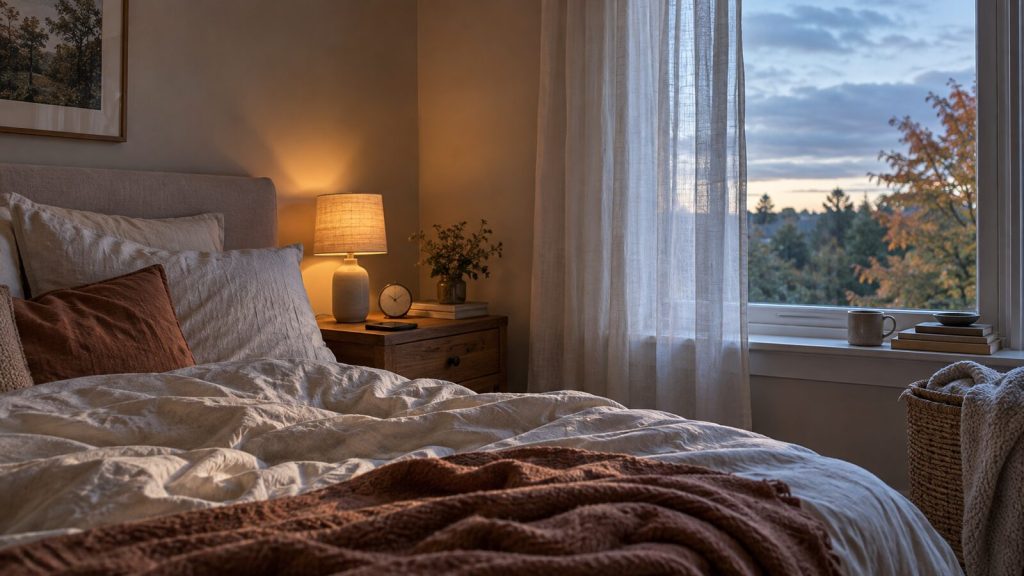
Longevity & Biohacking · The seasonal edit
The clocks have not changed yet. The light around them has. Before a ring, lamp or sleep stack gets the assignment, look at the signal your body has used all along.
The first clue is rarely dramatic. You turn on a lamp during dinner. The walk that happened naturally after work begins losing its place. Morning arrives at the same clock time, but it feels less convincing.
Then the dashboard gets involved. Your sleep score drifts. Your readiness number becomes disapproving. A sunrise clock, a light box and a pair of orange glasses begin following you around the internet.
It is tempting to tell a tidy story: shorter days changed your sleep, therefore a product must change it back. The biology is real. The conclusion is premature.
Light and darkness are powerful timing signals for the circadian system, but they are not the only ones. Work hours, meals, movement, temperature, stress, hormones, illness and the social shape of a week matter too. September often changes several of them at once.
The useful question is not, “Which sleep technology belongs on the nightstand?” It is: what changed in the light-and-life pattern—and what is the smallest intervention that addresses it?
The season changes the signal, not just the sunset
Circadian rhythms are roughly 24-hour patterns that help coordinate sleep, alertness, hormone release, appetite and temperature. The National Institute of General Medical Sciences describes light and dark as their strongest environmental influence. Light reaching the eyes helps the brain’s master clock coordinate timing, including the evening rise in melatonin.
That does not mean the body reads “September” on a calendar. It reads a changing pattern of light exposure.
As dawn arrives later and evening light recedes, an ordinary routine can quietly produce less daylight and more indoor light. A commute that once happened in brightness may move toward dusk. An after-dinner walk may disappear. The first strong light of the day may become an office ceiling rather than the outdoors, while evenings remain electrically bright.
The relevant signal is not simply how many hours of daylight exist. Timing, intensity, duration and the contrast between day and night all matter. Geography, weather, windows, work, caregiving, shift schedules and chronotype change the experience considerably.
This is why “get morning sunlight” is directionally useful but incomplete. Morning for whom? At what latitude? After which shift? Through which window? A foundation should be simple without pretending everyone lives the same day.
Seasonal sleep is real—and not a universal script
Research supports the possibility of seasonal changes in circadian and sleep timing, but it does not support a single autumn response for everyone.
In a small within-person study of 33 adults, Zerbini and colleagues measured dim-light melatonin onset and estimated sleep timing during summer and winter. Melatonin timing and sleep occurred about an hour earlier in summer than winter, with stronger effects among later chronotypes. Workdays and free days also mattered.
That is useful evidence of seasonal and social timing interacting. It is not a promise that every person’s sleep will shift by an hour, nor was it a September study of midlife women.
A separate real-world study followed 59 adults in the United Kingdom for about a week with wearable light sensors and sleep diaries. Higher light exposure before bed was associated with taking longer to fall asleep, while earlier sleep timing correlated with more robust daytime-versus-nighttime light patterns. But the sample was small, mostly younger than 35 and observational. Association is not proof that changing one lamp will solve insomnia.
Even intervention studies require proportion. A field experiment found that morning bright light improved sleep efficiency and next-morning alertness compared with ordinary office light—but it involved college students and one workweek. Interesting does not mean universal.
The honest conclusion is more modest: changing light exposure can influence sleep and circadian timing; the effect depends on timing, context and the person. That is enough reason to inspect the foundation before shopping.
Start with the light pattern you already have
The foundation is not a perfectly optimized lighting protocol. It is a day with a recognizable beginning, a reasonably protected ending and enough sleep opportunity between them.
Give the active part of the day some actual daylight
Look for a repeatable opportunity to be outdoors after waking or during the earlier part of your active day: a brief walk, coffee near the door, part of the commute or a lunch interval. Outdoor light is usually far brighter than ordinary indoor lighting, even when the day does not look impressive.
There is no universal number of minutes prescribed here. Cloud cover, latitude, season, timing, eye health and the rest of the light pattern all complicate a neat dose. Do not stare at the sun, and keep appropriate skin and eye protection.
The decision test is practical: will this daylight opportunity still exist when mornings or evenings become darker? If not, move the opportunity before buying a device designed to imitate what the schedule removed.
Keep one or two timing anchors steady
A stable wake time and a realistic sleep opportunity often tell the circadian system more than an elaborate evening ritual followed at wildly different hours.
The CDC’s sleep guidance recommends consistent bed and wake times and treats sleep quality as more than duration alone. Consistency does not require military precision, and it should not override recovery after illness or an unusually demanding period. It means avoiding a routine that asks the body to live in a different time zone every weekend.
Meals and movement can become secondary anchors. The goal is not to schedule every biological process. It is to notice whether September has moved dinner, exercise, work and bedtime later while the alarm remained immovable.
Let evening look different from daytime
You do not need to conduct the household by candlelight. You do need some contrast.
If the room is brilliantly lit until bed, start by reducing unnecessary ambient brightness and bringing the evening environment down gradually. A phone’s content can keep someone awake for reasons that have nothing to do with wavelength; light is only one part of the screen problem.
This is where the internet tends to sell certainty. Blue-blocking glasses may change a particular slice of light exposure, but they cannot create a consistent sleep opportunity, quiet a loud room or finish a stressful conversation. Before buying them, see whether simpler dimming and timing changes are possible.
Protect the sleep environment
Temperature, noise, comfort, alcohol, caffeine, pain, hot flashes, a partner’s schedule and a child appearing at 2:13 a.m. do not become irrelevant because circadian science is elegant.
The bedroom should support sleep rather than audition for a wellness catalogue: comfortably cool, reasonably dark and as quiet as real life allows. Fix the obvious friction first. Blackout curtains may be useful when unwanted light enters the room; they are not proof that the body needs total darkness at every hour of the day.
The device is a witness, not the intervention
A wearable can help show that bedtime moved later, wake time became less consistent or nighttime disruptions increased. It cannot establish that seasonal light caused the change.
Consumer devices estimate sleep from signals such as movement and heart rate. The American Academy of Sleep Medicine’s position statement says consumer sleep technologies should not be used to diagnose or treat sleep disorders, although the information may support a clinical conversation.
That distinction matters because dashboards are excellent at accepting credit. Suppose a woman moves her outdoor walk from a disappearing evening slot to lunchtime, dims the house earlier and protects a steadier wake time. Two weeks later, her sleep feels more settled and her wearable trend improves.
The ring did not improve her sleep. It recorded an improvement that followed changes in light and routine. It may be a useful witness; it is not the protagonist.
Use the same device and metric when comparing trends. Treat missing data as missing, not failure. If the number and lived experience disagree, Your Wearable Says You Slept Fine. You Disagree. Who’s Right? explains which question to trust first.
Put products in the testing layer
Once the foundation has been examined, some products may still solve a defined problem. This is where Evidence · Experience · Economics belongs.
Sunrise alarms and smart lighting
These may make a dark wake-up or gradual evening dimming easier. Their strongest case is often behavioral: the product helps create a repeatable cue.
Ask what the device actually controls. Does it make wake time more tolerable? Does it automate lighting you otherwise forget to adjust? Or is it promising “circadian optimization” without defining an outcome?
A useful automation does not need to be a medical treatment. But convenience should be priced as convenience.
Bright-light boxes
A clinical light box is not merely a cheerful lamp. Light therapy is a timed physiological intervention used for specific conditions, especially winter-pattern seasonal affective disorder. The National Institute of Mental Health describes commonly used devices as 10,000-lux boxes used on a schedule and designed to filter ultraviolet light. It also advises medical supervision for people with certain eye diseases or medications that increase light sensitivity.
Do not borrow a social-media protocol and assume brighter or longer is better. Timing can shift the circadian clock in different directions. If depression has a seasonal pattern, treat that as a health question—not a lamp-shopping personality trait.
Before buying, inspect the stated illuminance at the recommended distance, UV filtering, testing or certification information, instructions, warranty and return policy. Then ask whether the product and schedule match the outcome being addressed with a qualified professional.
Sleep rings, watches and headbands
These belong in the measurement layer unless a specific feature has been validated or cleared for a defined purpose. “Tracks sleep” is not the same claim as “improves sleep.” “AI insights” is not an outcome.
The buying questions in Before You Buy Another Wellness Device apply: What decision will the data change? How was the metric validated? What is the total cost? What happens to the data? What is the exit rule?
The E.E.E. verdict may be yes. It may also be: the evidence is interesting, the device adds friction, and the same money would buy better curtains or protect time for a clinician visit. That is not anti-technology. It is correct job placement.
Do not make “seasonal” explain too much
An earlier sunset can coexist with a different reason for disrupted sleep.
In midlife, hot flashes and night sweats can interrupt sleep, and mood changes may contribute too; the National Institute on Aging treats these as real menopause-related sleep considerations. The NHLBI notes that sleep-apnea risk rises during and after menopause and that women may present with insomnia, headaches, tiredness or frequent waking—not necessarily the stereotype someone expects.
Pain, restless legs, reflux, medications, alcohol, thyroid problems, anxiety, depression and caregiving disruptions can also matter. A tracker cannot rule them out, and a seasonal explanation should not delay assessment.
Pay attention to persistent insomnia, loud snoring or gasping, morning headaches, marked daytime sleepiness, worsening mood, or a change that is difficult to explain. The earlier article The 3 A.M. Wake-Up Is Not a Personality Flaw offers a fuller map of what can sit behind recurring midlife waking.
Try a seven-day light-and-life check
Use the new Fall Baseline as the starting point. For one ordinary week, record only:
- when you first spent time outdoors in daylight;
- approximate bedtime and wake time;
- whether evening lighting stayed bright until bed;
- substantial nighttime disruption; and
- one sentence about how restored you felt in the morning.
This is an AbundantlyMari observation exercise, not a validated assessment or diagnostic test.
At the end of the week, look for one vulnerable link. Perhaps outdoor time is happening only after dinner. Perhaps the family schedule has pushed everything later. Perhaps the room is darker, but hot flashes—not light—are doing the waking.
Change one foundational variable that fits your circumstances. Move an existing outdoor interval. Stabilize a wake-time range. Dim unnecessary evening lighting. Address an obvious environmental problem. Then observe without awarding causation too quickly.
If there is no meaningful decision to make, stop collecting. Your Wearable Is a Very Confident Intern is still the correct reporting line.
The longevity move is less glamorous than the gadget
Seasonal awareness is not seasonal panic. It is noticing that the conditions supporting sleep are changing before the problem becomes a winter identity.
The Longevity Hierarchy begins with foundations for a reason. Light timing, sleep opportunity and a workable routine may not look like biohacking, but they are the environment in which every sleep product has to prove itself.
Let the day become visibly daytime. Let evening become recognizably different. Give technology a narrow job. And if sleep is persistently difficult, let the next step be appropriate care rather than a more expensive dashboard.
The light is changing. The answer is not necessarily to buy something that glows.
Sources and further reading
- NIH / NIGMS: Circadian Rhythms
- Zerbini G, Winnebeck EC, Merrow M. Weekly, seasonal, and chronotype-dependent variation of dim-light melatonin onset. Journal of Pineal Research (2021)
- Didikoglu A, Lucas RJ, Brown TM. Associations between light exposure and sleep timing and sleepiness while awake in a sample of UK adults in everyday life. PNAS (2023)
- He M et al. Morning bright light improves nocturnal sleep and next-morning alertness among college students. Journal of Sleep Research (2023)
- CDC: About Sleep
- Khosla S et al. Consumer Sleep Technology: An American Academy of Sleep Medicine Position Statement. Journal of Clinical Sleep Medicine (2018)
- National Institute on Aging: Sleep Problems and Menopause
- NHLBI: Sleep Apnea and Women
- NIMH: Seasonal Affective Disorder
This article offers general education, not individual medical advice. Light therapy can affect circadian timing and may not be appropriate for everyone. Seek qualified guidance for persistent sleep difficulty, possible sleep apnea, significant mood changes, eye disease, or medications that increase light sensitivity. Do not start or change treatment because of a wearable score. See our editorial and wellness disclaimer.
 AbundantlyMari
Leave a comment